
De-CONNECT • Issue #03
At first, nothing stands out.
But if you stay a little longer,
you begin to see how things connect.
Not because something is strong or obvious,
but because small edges quietly guide your eyes.
This week, we learn to see how a scene becomes clear
through these quiet connections.
Pause & Notice
Slow down.
Don’t search for a subject.
Just notice where your eyes go.
Sometimes, it’s not one thing that catches your attention— it’s how different parts fit together.
De-CONNECT
Look around you.
Can you find:
- a line that leads your eyes somewhere?
- a boundary where two surfaces meet?
- a shift in light that defines a space?
It could be simple.
A wall and a floor. A shadow touching the ground. A railing cutting across a scene.
These edges help you understand what you see.
Basic Notice
This week is about one idea:
👉 Edges can organise a scene.
Not loud.
Not dramatic.
But they quietly guide your eyes
and help everything make sense.
What to look for
- Lines that lead your eyes
- Boundaries between surfaces
- Edges that connect different parts
If your eyes move smoothly through the scene,
the edges are working.
ARTIST SPOTLIGHT
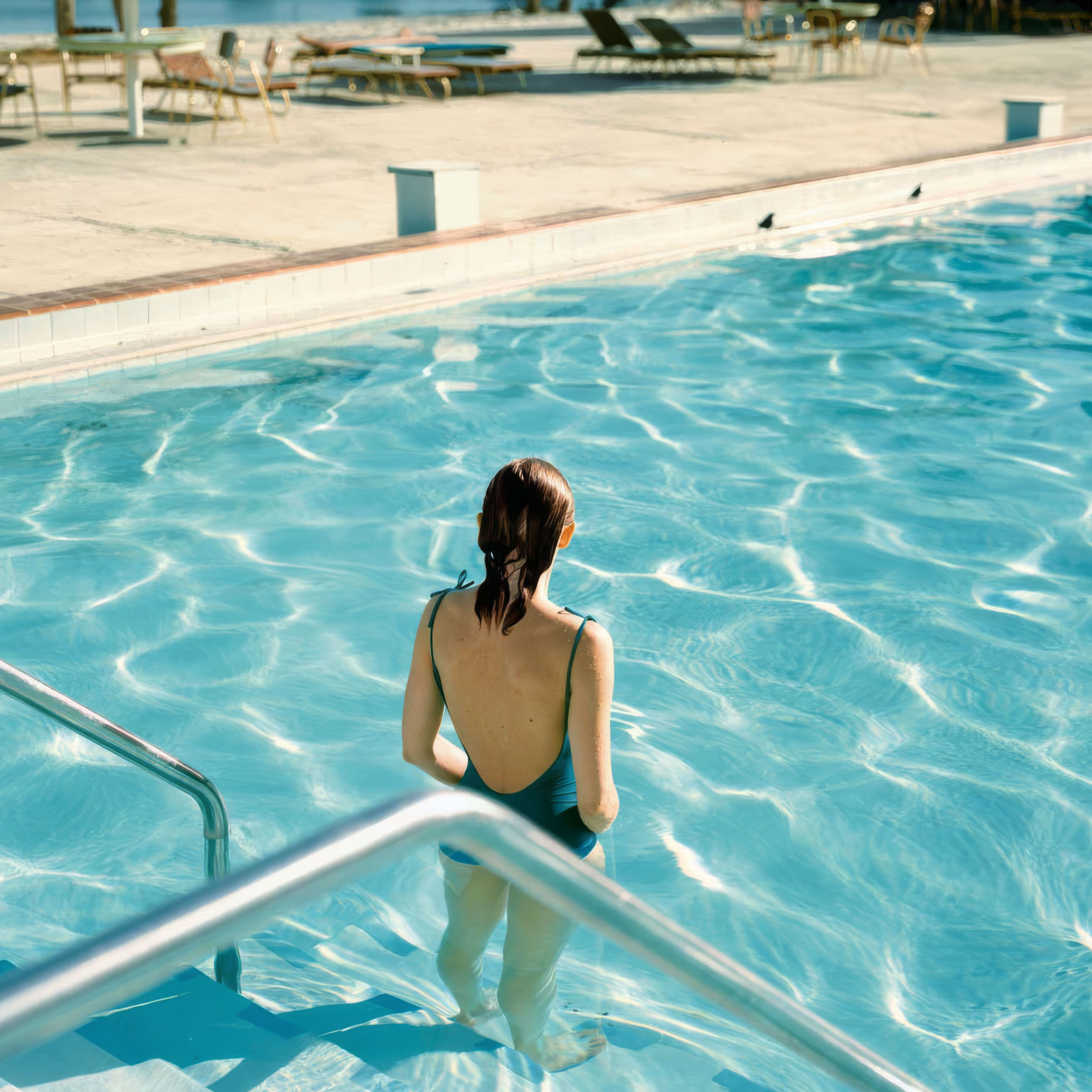
Stephen Shore —Causeway Inn, Tampa, Florida (1977)
See full image at
https://www.moma.org/collection/works/165379
A woman walks down into a swimming pool.
The water is bright and calm.
Light spreads gently across the surface.
A metal railing enters the frame at an angle.
The edge of the pool stretches across the background.
Beyond that, there are empty chairs and open space.
- Nothing is strong.
- Nothing is forced.
But everything feels clear.
What this teaches us
The subject is easy to see.
Not because of strong contrast, but because of how the scene is organised.
The edges guide your eyes:
→ along the railing
→ across the water
→ toward the far edge
→ then back to the subject
Each edge supports the next.
Nothing stands out too much. But everything works together.
This shows:
👉 Edges don’t need to be strong
👉 They just need to guide your attention
How it works
Your eyes follow structure.
Not just subjects.
When edges are placed well:
- they guide where you look
- they help you understand the space
- they make the scene feel calm and balanced
You may not notice the edges directly— but they are doing the work.
Practice
Try this:
- Find a simple scene (not busy)
- Look for at least 2 edges:
- one line (railing, wall, path)
- one boundary (light/shadow, floor/wall)
- Position yourself so these edges connect
- Place your subject within this structure
- Take the photo when your eyes move easily through the frame
You can also:
- use a railing or road to guide the eye
- use a horizontal line to stabilise the scene
- wait for a person to enter the space
👉 The goal is not just the subject
👉 The goal is how everything connects
How to adjust
• Too messy?
→ Simplify the scene
• No clear direction?
→ Find a stronger line
• Subject feels lost?
→ Adjust so edges lead toward it
Rules
- Don’t rely on strong contrast
- Use edges to guide, not dominate
- Keep the scene simple
You are not trying to make something loud.
You are learning to make something clear and steady.
The Bridge
This week, we learn a quiet skill.
Not how to make something stand out.
But how to make a scene hold together.
Edges are not just lines.
They guide your eyes, connect your scene, and help everything feel complete.
And when you start to see this,
you realise:
A strong photo is not always about what is obvious.
Sometimes, it is about what quietly holds everything in place.