
De-CONNECT • Issue #02
Shadow is not just darkness.
It is something real in your photo.
When light hits something, you can see it. When light does not reach, shadow appears.
But shadow is not empty. It has shape.
It takes up space.
Pause & Notice
Sometimes, when you look at a scene, you stop searching for a subject.
Your eyes slow down.
They begin to notice the darker parts.
You are not looking for what is missing.
You are noticing what is still there.
De-CONNECT
Look around you. You might see a wall where one side is bright, and the other side is dark.
You might see a shadow cutting across the ground.
Or a person standing near the edge of light.
Now ask yourself:
Does the shadow feel strong? Does it clearly divide the scene?
Do not fix it.
Do not brighten it.
Just notice:
Does the shadow hold the structure of what you see?
Basic Notice
Here is the key idea:
Shadow is structure.
It is not just behind things. It shapes the whole image.
A strong shadow can divide the frame. It can guide your eye.
It can make the scene feel clear.
If the shadow is weak, the photo feels messy.
If the shadow is strong,
everything falls into place.
ARTIST SPOTLIGHT
Fan Ho —Approaching Shadow (1954)
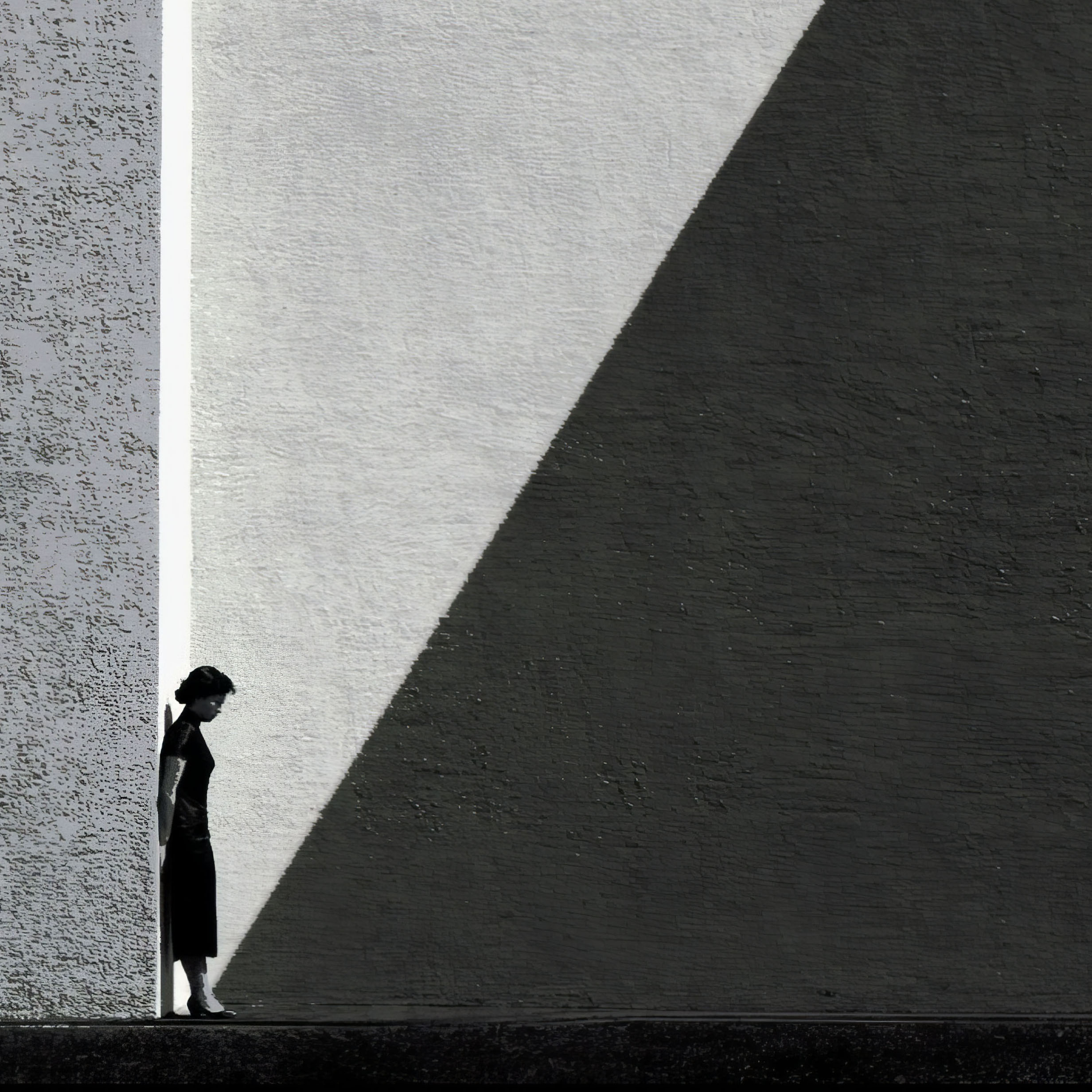
See the full image at
https://aboutphotography.blog/blog/story-of-approaching-shadow-by-fan-ho
A person stands close to a wall.
A large diagonal shadow cuts across the wall, splitting it into light and dark.
The person is small and placed near the edge.
The scene is simple, but the shadow is strong and clear.
What this teaches us
The shadow is the main subject.
It controls the whole image.
It divides the space.
It directs where your eye goes.
The person becomes secondary. This shows us something important:
Shadow can organise everything in the photo.
It also creates tension—
like the person is about to step into the dark.
How it works
Shadow is not just a dark area.
It is a tool.
It can:
- divide space
- create strong shapes
- guide attention
When used well, shadow becomes the structure of the image.
Practice
Find a place with strong light and shadow.
Look for:
walls
corridors
flat surfaces with sunlight
Now do this:
- Find a clear edge where light meets shadow
- Frame your shot so the shadow forms a strong shape (like a diagonal or triangle)
- Let the shadow take up a large part of the frame
- Wait for a person or object to enter the edge of the shadow
Then ask:
Does the shadow organise the whole picture?
If yes → take the photo
If no → adjust or wait
How to adjust
If the shadow is not clear:
→ move until the edge becomes sharp
If the scene feels messy:
→ simplify your frame
If the subject is too strong:
→ let the shadow dominate more
If nothing stands out:
→ wait for the right moment
Rules
- Use strong directional light
- Look for clear separation between light and shadow
- Keep the scene simple
- Let shadow take a big part of the frame
- Do not try to show everything
The Bridge
This is what you are learning:
Shadow is not just something you see.
It is something you can use.
It can organise space.
It can guide attention.
It can create meaning.
When you understand this, you are no longer just taking photos.
You are building the image.